Bulls, Bears and other Beasts

The Book run in two different ways, firstly a character Lalchand Gupta and how various event happened in his life in Dalal Street and Secondly how the stock market evolved since 1988

  • Jobbers were the speculators, who engage in the business of buy and sell securities, they create liquidity in the market and earn Bid-ask spread
  • Robbers were also like jobbers but they deal with large orders and their main motive is only profit not of client interest
  • At that time, insider trading was done by brokers and others with quite ease like Lalchand takes the help of his friend Rajesh (worked in stock exchange) to know about the price quoted by other dealers
  • Auction system took place in BSE at that time, if any client or broker failed to deliver share, his position is auctioned
  • Front-running was done by brokers, they place their order before client order and earn profit through such trade. But in 1994, NSE came and introduce screen-based trading (client can verify what price their shares were traded for)
  • The Big bull Harshad Mehta scam:
    • Harshad Mehta has taken advantage of look holes in Banking system as bank traded with Bank receipts to get money from one bank
    • Harshad issued fake bank receipts and park those money in stock market in his favourite stocks
    • This scam was exposed and Harshad was arrested
  • Manmohan Singh opened up the economy and SEBI was introduced as stock market regulator in India
  • SEBI tightened the rules and regulation by introducing new rules at different point of time and all the stock broker has to re-register with SEBI to continue trading
  • Another Big bull Ketan Parekh known as new Pied Piper of Dalal Street scam occurred
    • Ketan accept money from promoters of company to took their share price up
    • And as share price goes up Ketan liquidate his position and earn through inflated price likewise he had taken money from Madhavapura Mercantile Commercial Bank (MMCB) to boost up stock price but as bear cartel became bearish on those stocks its price came down and investor lost 2000 crore and Ketan was immediately arrested and ban for 15 years for trading
  • just when it seemed that market had stabilized the 9/11 attack on the twin tower of the US World Trade Centre, market again struggled and Sensex slid 15% to 8-year low
  • India was struggling there were no liquidity in stock exchange but there came booster in the form of Maruti Udyog IPO, which got a great response, people buy it as a value stock
  • Promoters started manipulating the accounts by increasing revenues through recording sales earlier, not making provisions, pushing sales by increasing credit period etc. to gets fund easily
  • And also, many promoters started hiring people to raise their company’s share price instead of focusing on core business, which is a worrisome situation
  • The Reliance Power IPO, which blocked a fatty liquidity of market as it was even subscribed by middle class and lower-class people as assured return IPO, which eventually failed the expectation and this IPO affected Coal India IPO (a good value investor stock)
  • Some of the global events like Quantitative Easing, Southeast Asia Scam which affected the Indian stock Market and How FII started taking their money out of India and then the crash of market
  • Even domestic events like Terrorist Attack in stock exchange, change of government, various Scams, Election affected stock market and How the stock exchange handled those situations
  • UTI mutual fund US-64 scam of selling units at any price which have no relation with NAV, UTI would increase the sales and purchase of US-64 by 20 Paisa every month and return those moneys to investors who redeem as inflow dried up, no money left and UTI started Defaulting on redemption and because of which many people committee suicides
  • In 2009, Satyam Scam of manipulating books by showing non-existence Revenues and Bank balance and then the news of world bank of Banning Satyam to do business for 8 years, which put the promoter B. Ramalinga Raju in worst position and he suffer huge losses
  • RadhaKishna Damani the finest All-rounder of stock market due to his skill of selecting the perfect stock and also a great entrepreneur as he had started D-Mart from scratch with the philosophy that customer would be looking for variety in his store at a good price
  • Many promoters started issuing FCCB- Foreign currency convertible Bond, which is issued in another country and can be converted into equity shares. The conversion price Was at 15 to 20% premium to the current market price of the stock (issued for 3-5 years) Promoters thought that they would not have to pay the debt as at the time of conversion there share price would be much higher than the conversion value but it turned out to be opposite and all investor want their principal back, which became burden for company

PRE-SUASION

What is Pre-Suasion?

  • Pre-suasion—the process of arranging for recipients to be receptive to a message before they encounter it
  • Per-suasion teaches us, what to say before making a request to someone(pre-suader), so that he may agree with it
  • To Persuade someone it is necessary to Persuade optimally

Key Factors to Persuade someone:

Attention:

  • When you pay attention to a particular thing it will automatically become more important to you
  • According to this view, in an election which ever political party is seen by voter to have the superior appearance on the issue, highest on the media at that moment will likely win
  • This technique means people will give more importance to things, which media is currently reporting as it become trend
  • Attention can also be grab by asking Right questions as ‘people usually look for confirmation of the idea rather than for disconfirmation’ (called as ‘positive test strategy’)
  • Example of asking people whether they are unhappy? people will search for movement in which they are unhappy and tell yes, they are unhappy
  • Another way to influence the people or the employee working in the company is never use language associated with violence like replacing ‘target’ and ‘beat’ with ‘goal’ and ‘outdistance’
  • Another way is What’s-focal-is-presumed-causal phenomenon. This means whoever’s face was more visible was judged be more casual
  • For Example: The observer was placed in such a way that they can see only one-person face and they were asked which one was dominating the conversation. They always answer the one whose face was most visible to them
  • Ways to Grab Attention:
    • Sex: Sexual stimuli can grab human attention easily. For example, a recent field experiment found that only 20% of men would agree to help a woman after having been asked for directions to Martin Street, but almost twice as many agreed to help after having been asked for directions to valentine street.
    • Threatening: Humans gave Special attention to threatening stimuli. A great way to convey highly threatening news without raising people’s defences is to give a real and scary warning and then present the solutions.
    • Something Different: To grab attention of someone the attention material should be new, or different from others. For example: you walk from one room to another to do something specific, but once there you forgot why you come there, which means entering a new environment disrupts our memory
  • Another way to grab attention of audience is Self. If something is related with us, we will give that thing more important than other
  • For example: take a group photo and pass on the camera, everyone will look themselves first
  • Same way unfinished things also grab attention as Unfinished task is more memorable and anything tell unfinished gets much attention. For Example: advertising of soft drinks and toothpaste: students were better able to recall the details when the researchers stopped the ads 4-5 seconds before their natural end.
  • Even Geographies or area you work matters. Cialdini said, “the work he had done at home was miles better than what he has done at the University”.
  • Cialdini give six main principles of human social influence: reciprocation, liking, social proof, authority, scarcity and consistency
    • Reciprocation: this principle states that those who have given benefits to us are entitled to get benefit from us in return
    • Liking: Salesman who is liked by customer will see their sales grow as people will purchase from him only. To attract someone Cialdini gave two things in Liking i.e. similarities (People like those people who are similar to them) and Compliments (People like complements about them)
    • Social Proof: Two main components of social proof are validity (If people came to know that others have given similar respond, then that respond become more valid and practical) and feasibility (others can do than why not i?)
    • Authority: For example: If a person receives advice from an expert, they gave it more priorities. Two highly persuasive qualities are expertise and trustworthiness
    • Scarcity: People want more what they have less
    • Consistency: Human tendency is normally; they want to be consistent with their existence commitments

Unity:

  • The feeling of being a part of group or something like that is unity. the experience of unity is not about simple similarities it’s about shared identities like that person is like us (in place of using “oh, that person is of us” in place of “oh, that person is like us”)
  • When people act in unison not only see themselves moral alike, evaluate one another more positively afterwards
  • Music can also influence people Music does not deal with the rational part of the brain but with the emotional one. Also, man with guitar asking for phone number to a girl is more effective than a person without

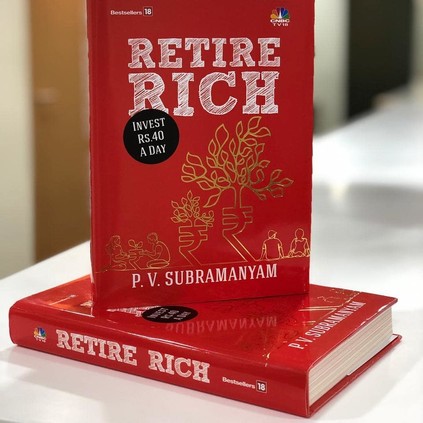
RETIRE RICH

About Author

  • He is the CEO of www.subramoney.com
  • An Accountant by Qualification and a lawyer by training
  • He has conducted over 1000 training and financial communication session across the country
  • His mission is to equip smart people with the tools to get richer

About book

  • What is retirement: Is Retirement an Age or Amount of Money?  It is just a phase where your daily income is now no longer available and your saving and investment becomes your ultimate supporter
  • Retirement is Something Harsh to digest, but need to be accepted
  • Important part in this stage is how well you manage your money in Saving & Investing (Accumulation Stage) and in Retirement (Withdrawal Stage)
  • How much You need to survive at your Non-earning period depend on 4 factors:
    • How long you and your spouse will live
    • Performance of your investment portfolio
    • The plan ruiner (Inflation)
    • How well you have predicted your expenses and manage your withdrawals from your corpus at retirement
  • Steps to Reach your corpus:
    • How much your Retirement Expense will be both day to day one as well as your comfort one (House, Cars, etc)
    • Make A Realistic estimate of Expense
    • Next, how much you have and how much you owe (Asset & Liabilities, Cash Flow & insurance)
    • Your Will
    • Compare your Income and Expense and start Investing for Retirement (Net worth)
    • Your insurance plans
    • Goal Setting Should be SMART:
      • S Specific (age/term to retire)
      • M Measurable (Measure your corpus with your earning and expenses)
      • A Achievable (Corpus value should be achievable)                                      
      • R Realistic (Planning should be real not fictitious)                                                            
      • T Tracked (Goal should be tracked and if necessary changes needed than should be done)
  • Investing 40 a day can help you to become Rich:

 “If You spend 40 a day in cigarettes or 2,000 in Restaurant or 10,000 a month in Shopping. Save them and Invest. This Amount will grow to Millions in 30 years! If u invest in Equity, Sensex, PPF, etc. Just Invest It And be a Millionaire. Even you can save more by using products only when you actually need them”

  • Compounding is the most powerful shastra of planning it is interest on interest and its effect is seen in later years only if you are consistent towards your investment and don’t withdraw that amount before you planned
  • Don’t forget Inflation in all this as the inflation is the biggest destructor of Retirement planning as higher the inflation rate than higher the prices of goods and services at retirement. So, one should take Inflation very seriously at the time of planning
  • One should avoid Ponzi schemes in their planning as such schemes looks attractive, but eventually they will ruin your corpus (Especially old people)
  • Women’s should also need to plan for Retirement because they work for a lesser period and live longer
  • One can use Reverse mortgage also to get a part of regular income from fixed assets (Best in time when person is asset rich but income poor)
  • Annuity can also help in Retirement to ensure a regular flow of money at the time of non-earning age
  • Some of the Factors which will Avoid Losing your corpus are:
    • Avoid high-pressure sales techniques
    • Say no to strangers (about Ponzi scheme)
    • Always ask to think about the offer for a few days or put him off by saying that you need to consult with your children
    • Say “I do not understand “(Best way to avoid)
    • Never, ever give credit details over phone (Fraud calls)
    • Avoid letters or calls that claim you have won a prize (Trending Nowadays)

THE UNUSUAL BILLIONAIRES

About Author

  • Saurabh Mukherjea was the CEO of Institutional Equities for Ambit Capital, an Indian investment bank.
  •  In 2014 and 2015, he was rated as the leading equity strategist in India by the Asia money polls.
  • Mukherjea has spent most of the past decade trying to construct and implement systematic methods for analysing Indian companies in the midst of the chaos that surrounds the Indian stock market.
  • A London School of Economics alumnus, Mukherjea is also a CFA charter holder.

How Saurab Mukherjee has identify such companies?

  • Saurab Mukherjee has used Robert Kirby’s “Coffee Can Portfolio” model. The formula to derive it is:
    • For Non-Financial Service Firm (Decade):
      • A 10% Revenue Growth every year
      • And at least 15% of Return on Capital Employee (ROCE)
    • For Financial Services Firm (Decade):
      • Return on Equity (ROE) of at least 15% every year
      • And Loan Book Growth of 15% every year
  • Mukherjea identified 8 companies According to this:
    • Asian Paints`
    • Berger Paints
    • Marico
    • Page Industries
    • Axis Bank Ltd
    • HDFC Bank Ltd
    • Astral Poly
    • ITC
  • The CCP has outperform Sensex every year and Sometimes by More than 25%

Asian Paints

  • Asian paint from start has focused on core business i.e. paint segment only
  • This is the only company in the paint segment which has not seen a change in its controlling shareholders in the past seventy years
  • Creating a unique working culture that nurtures talent (Hiring from IIMs) and gave them full freedom to work
  • Focus on technology to reduce cost & increase efficiencies: colour tinting machines & IT system
  • Good relationship with dealers
  • Prudent capital allocation and Continues innovation
  • Branding plays a key role in making Asian paints as the largest paint company in India

Berger Paints

  • Berger paint is the second largest paint company in India
  • Berger paint has seen so much change in ownership from Lewis Berger, a British manufacturer to Vijay Mallya, who sold to Dhingra brothers at last
  • Berger Paint has focused on core business only and had not diversified the business
  • Focus on hiring talents from IIMs and giving them full responsibility and authority to work
  • Continues innovation in product and launching new products with special characteristics
  • Strong relationship with distributors (Giving benefits to them like Rebates, favourable credit terms, and rewards & gifts like international holidays)
  • Berger had A strong supply chain which keep a company inventory costs under control and keeps the dealer happy
  • Aggressive advertisement campaign to focus on Branding

Marico

  • Marico’s journey is unique from a commodities-driven firm to a fast-moving consumer goods (FMCG)
  • Marico’s most popular product is Parachute and Saffola
  • Marico had completely focused on its core business and product specially parachute and saffola
  • Marico had continuously focused on innovation in packing & product to attract customers
  • Unique work culture (no attendance register, remuneration based on performance, no cabins)
  • Maintain relationship with distributors like sending them for foreign trips, etc.
  • Extending winning brands like Nihar shanti Amla, VAHO, Hair & Care etc and divesting low margin brands like sweekar
  • Using auto-replenishment, demand driven model (where if distributors inventory depleted than company send fresh one), unlike other FMCG pushing their inventory to distributors
  • Prudent capital allocation- First company to declare quarterly dividends in FMCG
  • Diversifying its business in various categories like oats, edible oil, hair nourishment products etc and in various nations

Page Industries

  • In 1990, Jockey International (USA) gave the exclusive licence to Sindhi business family Genomals to launch and expand Jockey’s presence in India
  • Within two decades, Page Industries became the biggest license company of jockey in world
  • Page had focused on its core business i.e. Jockey only
  • Delivering a differential product which is upgraded year after year to provide comfort, durability and affordability with fresh design
  • In house manufacturing of elastics to reduce cost rather than outsourcing manufacturing
  • Various facilities were provided to workers to avoid labour strike like free lunch, crèche facility, proper sanitisation and health facility in factories etc
  • Quality of product and supply chain management (Strong ties with distribution channel and especially mom & pop store) is the two strongest aspect of Jockey compared to its peers
  • Doesn’t acquired company which is not directly related to core business and only acquisition will occur if the acquire company post at least 20% CAGR

Axis Bank

  • Axis Bank was backed by UTI (Unit Trust of India), India’s largest mutual fund house and some of the professional bankers of Public sector. Axis bank had a slow start, when it started its operation in 1994
  • However, under the leaderships of Supriya Gupta, P Jayendra Nayak and Shikha Sharma, the bank has now become the country’s third largest private bank
  • Axis bank has Increased ATMs & branches at much faster rate than its competitors (to increase CASA)
  • Axis bank has Largest ATMs and Branches in India
  • Increase the focus on Advertising to build a strong Branding
  • Innovation in products like launching its app for digital banking and Aadhar base e-kyc etc
  • Providing better facilities to clients like creche, ESOP, adding accident insurance cover of 20000 to salary account etc

HDFC Bank

  • HDFC received its banking licence in 1994 and its MD Deepak Parekh roped in Aditya Puri to head the bank since inception.
  • Mukherjea writes HDFC Bank focused on two key principles – building a stable and low-cost liability base, and winning clients by offering unique solutions
  • HDFC Focused on building a granular, low cost franchise along with a market-leading position in most retail product since its start
  • HDFC had Taken minimum risk (when other banks were focusing on personal loan and credit cards, HDFC was least interested (Bank suffers huge losses for that except HDFC))
  • Continues innovation ahead of peers (ten-second personal loan approval, automated settlement system for stock market, etc)
  • HDFC had Focused mainly on profitability over growth
  • Money spent by bank in advertisement was much lower than their peers, even HDFC Bank didn’t use celebrity to build their brand name

Astral poly

  • Astral Poly Technik Limited is engaged in manufacturing and trading of pipes, fittings and adhesive solutions.
  • The company’s managing director Sandeep Engineer start was rough before building a profitable firm to turn it into India’s largest manufacture of Chlorinated polyvinyl chloride (CPVC) – an expensive, but high-quality alternative to GI pipes
  • Astral Pipes Focused on core business (CPVC pipes)
  • Continuous innovation in product to stay ahead of competitors
  • Recently, it had installed robotic truck- fitting machine to reduce loading time by more than half
  • Astral was also the first company to train plumbers and certifying them
  • Astral was also the first company to start barcoding on pipes to prevent duplicates
  • In India, to keep focus on his CPVC pipes, Engineer sold products at loss (Huge impact)
  • Focusing on plumbers as they are the ultimate decider of pipes
  • Aggressive branding (Full profit of FY05 was spend in advertisement and unique advertisement like advertising on buses & rickshaw and at wankhede stadium)
  • Treat their employees from watchman to promoters equally (all have same uniform)

ITC Limited

  • Unlike other companies ITC didn’t stuck to its core business of cigarettes instead diversifying its business in Financial services, hotels, IT, etc
  •  But he never compromised on cigarettes market share and focused on it along with other business
  • Consistent performance is due to:
  • The quantum of unrelated capex has not stressed the balance sheet
  • 50% of cash flow generated from operation has been paid out as dividend from last decade
  • 35% of cash flow from operation has been invested in business which generate healthy ROCEs